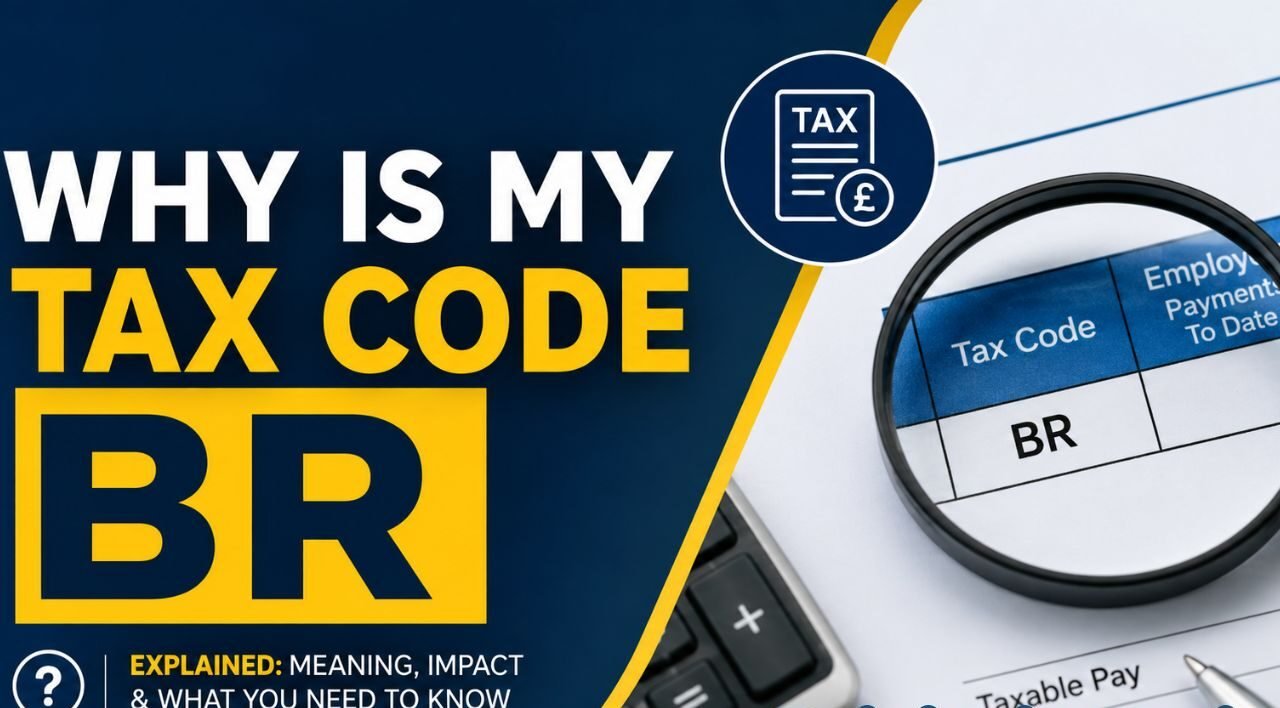
If you have recently checked your payslip and noticed the tax code BR, you may be wondering, “why is my tax code BR?” This is one of the most common questions asked by employees across the United Kingdom, particularly those who have started a new job, taken on a second source of income, or experienced changes in their employment circumstances.
Understanding your tax code is important because it directly affects how much Income Tax is deducted from your earnings. A tax code that is incorrect can result in paying too much tax or, in some cases, too little tax. While the BR tax code is not necessarily a mistake, it often raises concerns because it means your income is being taxed differently from what many employees expect.
In this comprehensive guide, we will explain exactly what the BR tax code means, why HM Revenue and Customs (HMRC) may have assigned it to you, how it affects your pay, and what steps you should take if you believe it is incorrect. By the end of this article, you will have a clear understanding of the BR tax code and know how to ensure you are paying the correct amount of tax.
What Is a Tax Code?
Before examining the BR tax code specifically, it is important to understand what a tax code actually is.
A tax code is a combination of letters and numbers used by HMRC to tell employers how much Income Tax should be deducted from an employee’s wages through the Pay As You Earn (PAYE) system.
The tax code reflects your tax-free Personal Allowance and any adjustments HMRC has made based on your circumstances. Employers use the tax code supplied by HMRC to calculate the correct amount of tax to deduct before paying your salary.
Most employees in the UK have a standard tax code, which allows them to earn a certain amount each year before paying Income Tax. However, there are several special tax codes that apply in specific situations, and BR is one of them.
What Does the BR Tax Code Mean?
The BR tax code stands for Basic Rate.
When HMRC assigns the BR tax code to a source of income, it means all income from that employment or pension is taxed at the basic rate of Income Tax. No Personal Allowance is applied to that income source.
In practical terms, every pound earned under a BR tax code is taxed at the basic rate without any tax-free allowance being deducted first.
For many people, this can result in larger tax deductions from their wages than expected.
The BR tax code is generally used when HMRC believes your Personal Allowance is already being used elsewhere.
Why Is My Tax Code BR?
There are several reasons why you may have received the BR tax code. Understanding the specific reason is essential for determining whether the code is correct.
You Have More Than One Job
One of the most common reasons for a BR tax code is having multiple jobs.
Every taxpayer generally receives one Personal Allowance each tax year. HMRC typically allocates this allowance to the job that provides the highest income.
If you take on a second job, HMRC may apply the BR tax code to that employment because your Personal Allowance is already being used against your main salary.
For example, if your primary job uses your full Personal Allowance, any income from a second job may be taxed entirely at the basic rate.
In this situation, a BR tax code is often correct.
You Have Started a New Job
When starting a new job, your employer needs accurate tax information to apply the correct tax code.
If you do not provide a recent P45 from your previous employer or complete the necessary starter checklist correctly, HMRC may temporarily assign a BR tax code.
This often happens while HMRC gathers sufficient information about your employment history and tax position.
Once the correct details are received and processed, your tax code may be updated automatically.
You Receive a Workplace Pension
Individuals receiving both employment income and pension income may sometimes be given a BR tax code on one source of income.
HMRC may decide to apply the Personal Allowance against one income stream while taxing the other at the basic rate.
This ensures the allowance is not used twice.
HMRC Does Not Have Complete Information
Sometimes a BR tax code is applied because HMRC’s records are incomplete or outdated.
This can happen if:
You recently changed jobs.
You returned to work after a break.
You moved from self-employment to employment.
Your employer submitted incorrect payroll information.
HMRC has not yet processed recent changes.
In such cases, the BR code may be temporary until the correct information is received.
Emergency Tax Situations
The BR code is sometimes used as part of an emergency tax arrangement.
When HMRC lacks sufficient information to calculate your correct tax position, a temporary tax code may be issued.
Although emergency tax codes often appear in different formats, BR can occasionally be used until the situation is clarified.
You Have Used Your Personal Allowance Elsewhere
Your Personal Allowance can only be applied once.
If HMRC believes your tax-free allowance is already fully allocated to another employment, pension, or income source, the BR code may be assigned to additional earnings.
This prevents taxpayers from receiving multiple Personal Allowances simultaneously.
How Does the BR Tax Code Affect My Pay?
The impact of a BR tax code depends largely on your individual circumstances.
Since no Personal Allowance is applied to income under a BR code, all earnings from that employment are taxed at the basic rate.
As a result, your take-home pay may be lower than expected.
For employees with a second job, this arrangement is often appropriate because their Personal Allowance is already being used elsewhere.
However, if the BR code has been applied incorrectly to your main job, you could end up paying significantly more tax than necessary.
This is why it is important to check your tax code whenever you change employment or notice unusual deductions on your payslip.
Is the BR Tax Code Always Wrong?
A common misconception is that the BR tax code automatically indicates an error.
In reality, the BR code can be completely correct depending on your circumstances.
For example, if you have a full-time job and a part-time evening job, HMRC may allocate your Personal Allowance to the full-time position and apply the BR code to the part-time role.
This ensures that the correct amount of tax is collected overall.
The key question is not whether you have a BR tax code but whether it accurately reflects your tax situation.
How Can I Check If My BR Tax Code Is Correct?
The first step is to review your employment and income arrangements.
Consider whether you have more than one source of taxable income.
Think about whether you recently changed jobs, started receiving a pension, or experienced another significant financial change.
You should also compare your tax code with any notices received from HMRC.
Tax code notices explain why a particular code has been assigned and often provide valuable information about the calculations involved.
Reviewing recent payslips can also help identify when the BR code was introduced and whether it coincided with a change in your circumstances.
What Should My Tax Code Be Instead of BR?
There is no universal alternative tax code because the correct code depends on individual circumstances.
Many employees have a standard tax code reflecting the full Personal Allowance available for the tax year.
Others may have adjusted tax codes due to benefits, underpaid tax from previous years, or other HMRC adjustments.
The important point is that the correct tax code should accurately represent your personal tax position.
If your BR code appears incorrect, HMRC can review your circumstances and issue an updated code if necessary.
What Happens If My Main Job Has a BR Tax Code?
If your main employment has been assigned a BR tax code incorrectly, you may be paying too much tax.
This is because your Personal Allowance is not being applied where it should be.
As a result, every pound of your salary is taxed from the start rather than allowing a portion to be tax-free.
Employees in this situation often notice lower take-home pay than expected.
Fortunately, if the error is corrected, HMRC usually adjusts the tax position and refunds any overpaid tax.
How Do I Contact HMRC About a BR Tax Code?
If you believe your BR tax code is incorrect, you should contact HMRC directly.
Before doing so, gather relevant information, including:
Your National Insurance number.
Recent payslips.
Details of all jobs and pensions.
Your employer’s PAYE reference if available.
Having accurate information ready can help HMRC review your tax position more efficiently.
In many cases, tax code corrections can be processed relatively quickly once the necessary details have been verified.
Can I Get a Tax Refund If the BR Code Was Wrong?
Yes, many people receive tax refunds after an incorrect BR tax code is corrected.
If HMRC determines that you have paid too much tax, they will usually arrange a refund.
The refund may be processed through your payroll if the correction occurs during the tax year.
Alternatively, HMRC may issue a direct repayment after reviewing your records.
The amount refunded depends on how long the incorrect code was applied and the amount of excess tax paid.
How Long Does It Take to Correct a BR Tax Code?
The timeframe varies depending on the complexity of the case and the availability of accurate information.
Simple cases involving a recent job change may be resolved within a few weeks.
More complex situations involving multiple income sources can take longer.
Once HMRC updates your tax code, your employer will usually receive the revised code electronically and apply it through payroll.
Any necessary adjustments are typically reflected in a subsequent payslip.
Common Situations That Lead to a BR Tax Code
Many taxpayers encounter the BR tax code during specific life or career events.
Starting a second job is one of the most common triggers.
Changing employers can also result in a temporary BR code while payroll records are updated.
Retirees who continue working may see a BR code applied to one source of income.
Individuals receiving occupational pensions alongside employment income frequently encounter this tax code as well.
Understanding these common scenarios helps reduce confusion and enables taxpayers to recognise when the code may be entirely appropriate.
How the PAYE System Uses the BR Tax Code
The PAYE system relies on tax codes to determine deductions throughout the year.
When a BR code is assigned, payroll software automatically taxes earnings at the basic rate.
The system does not consider a tax-free allowance for that income source.
This approach simplifies tax collection where Personal Allowances have already been allocated elsewhere.
Although the system is generally effective, errors can occur when information is missing or employment changes are not processed promptly.
Can a BR Tax Code Cause Underpayment of Tax?
In some situations, a BR tax code can actually help prevent underpayment.
By taxing all earnings from a secondary source at the basic rate, HMRC reduces the risk of insufficient tax being collected.
However, for higher-rate taxpayers, the BR code may not always collect enough tax because income is taxed only at the basic rate through PAYE.
Additional tax liabilities may still arise through HMRC calculations or self-assessment processes.
BR Tax Code and Part-Time Work
Many people with part-time jobs encounter the BR tax code.
If your Personal Allowance is already allocated to a full-time position, a part-time job may be taxed entirely at the basic rate.
Although this can initially seem unfair, it often reflects the correct overall tax treatment.
The key factor is whether your Personal Allowance is already being fully utilised elsewhere.
BR Tax Code and Pension Income
Pensioners frequently ask why they have a BR tax code.
When receiving both pension income and employment income, HMRC must decide where to allocate the Personal Allowance.
One income source may receive the allowance while another receives the BR code.
This arrangement helps ensure the allowance is used only once and prevents duplication.
How to Avoid Future Tax Code Problems
While not all tax code issues can be prevented, there are several steps that can reduce the likelihood of problems.
Always provide your P45 when starting a new job.
Complete starter forms accurately.
Check payslips regularly.
Review tax code notices from HMRC.
Inform HMRC promptly when your circumstances change.
These simple actions can help ensure your tax records remain accurate and up to date.
Understanding Other Common Tax Codes
Although BR is widely recognised, several other tax codes are commonly used in the UK.
Some indicate standard Personal Allowance entitlement.
Others are used for emergency tax situations, Scottish taxpayers, Welsh taxpayers, or circumstances involving multiple income sources.
Understanding that tax codes serve different purposes can make the BR code seem less alarming.
In many cases, it is simply one part of HMRC’s broader system for allocating allowances and collecting tax correctly.
Frequently Asked Questions About the BR Tax Code
Many employees wonder whether they should panic when they see a BR tax code on their payslip.
The answer is generally no. The code may be entirely correct depending on your circumstances.
Another common question concerns whether HMRC automatically corrects BR codes. In some cases, yes, especially when updated employment information becomes available. However, it is still wise to check your tax code and contact HMRC if something appears wrong.
People also frequently ask whether they will lose money permanently if they have paid too much tax under a BR code. In most cases, overpaid tax can be refunded once the issue is identified and corrected.
Conclusion
If you are asking, “why is my tax code BR?”, the answer usually relates to how HMRC has allocated your Personal Allowance. The BR tax code means that all income from a particular job or pension is being taxed at the basic rate without any tax-free allowance applied.
For many people, especially those with multiple jobs or income sources, the BR tax code is completely correct. However, it can also appear due to incomplete information, recent employment changes, or administrative errors. Because an incorrect BR code can lead to overpayment of tax, it is important to review your circumstances carefully and ensure HMRC’s records are accurate.
Checking your payslips, understanding your income sources, and communicating with HMRC when necessary can help ensure you pay the correct amount of tax. While seeing the BR tax code may initially cause concern, understanding how it works allows you to take appropriate action and manage your tax affairs with confidence.
You may also read: Why Electric Vans Are Growing in Popularity