Understanding tax codes is an essential part of managing your finances in the United Kingdom. Many employees notice a tax code on their payslip but often do not fully understand what it means or how it affects their earnings. One tax code that frequently causes confusion is the BR M1 tax code.
If you have recently changed jobs, started a second job, received an unexpected payslip adjustment, or noticed that your take-home pay is lower than expected, you may have been assigned the BR M1 tax code. While this tax code is not necessarily an error, it can have a significant impact on the amount of Income Tax deducted from your wages.
This comprehensive guide explains everything you need to know about the BR M1 tax code in the UK. We will explore what it means, why HM Revenue and Customs (HMRC) issues it, how it affects your salary, when it should be used, common mistakes, and what you can do if you believe your tax code is incorrect.
By the end of this article, you will have a clear understanding of the BR M1 tax code and how to ensure you are paying the correct amount of tax.
What Is the BR M1 Tax Code?
The BR M1 tax code is a temporary tax code used by HMRC under the Pay As You Earn (PAYE) system.
The letters and numbers within the code each have a specific meaning.
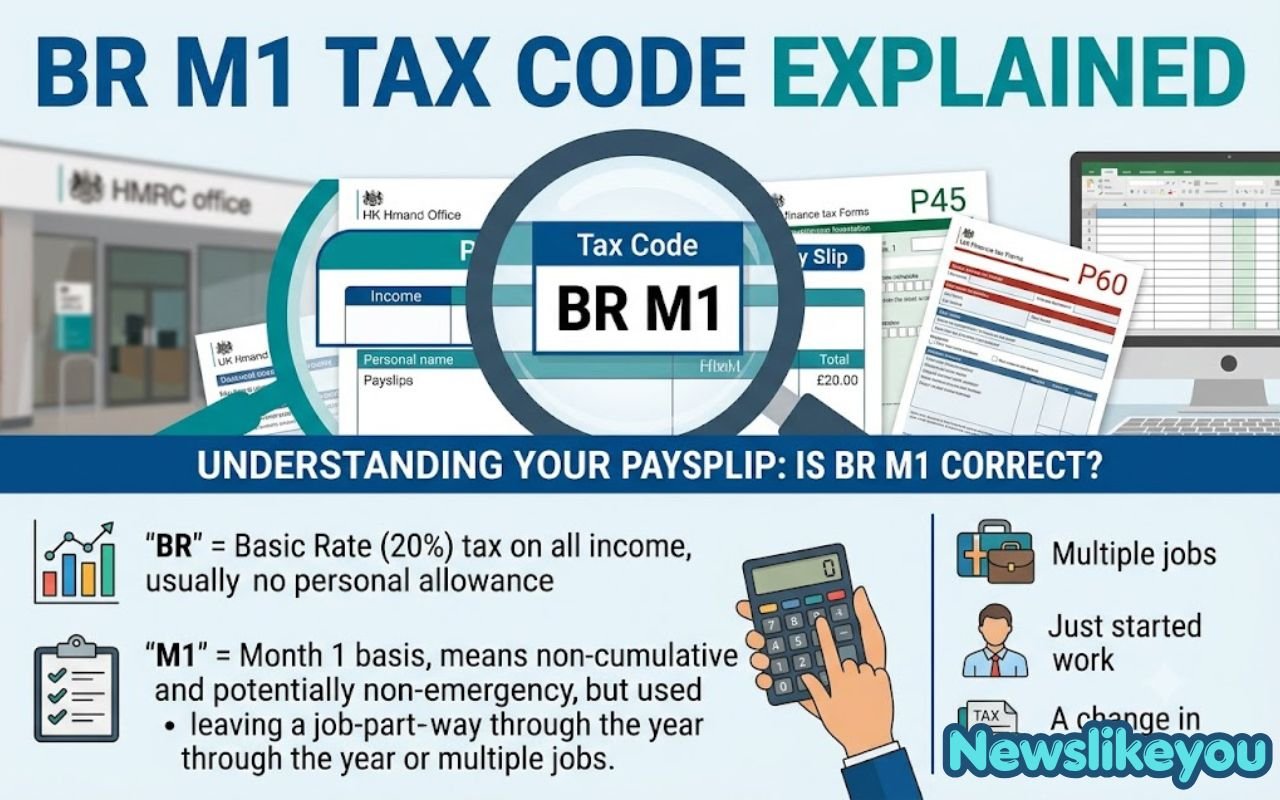
The “BR” element stands for “Basic Rate”. This means all taxable income from that employment is taxed at the basic rate of Income Tax without taking any personal allowance into account.
The “M1” element stands for “Month 1”. This indicates that the tax is being calculated on a non-cumulative basis. In other words, each month’s tax calculation is treated independently rather than taking previous pay and tax deductions into account.
When combined, the BR M1 tax code means that all income from that particular employment is taxed at the basic rate, and the payroll system calculates tax only for the current pay period.
Understanding the Basic Rate of Tax
The UK Income Tax system includes different tax bands.
The basic rate is the standard tax rate applied to earnings within a specific income range. Under the BR tax code, every pound earned from that job is taxed at the basic rate without applying any tax-free personal allowance.
Normally, most employees receive a personal allowance that allows them to earn a certain amount before paying Income Tax. However, under the BR M1 tax code, that allowance is not allocated to the employment where the code is being used.
As a result, employees often pay more tax than expected until their tax situation is corrected.
What Does the M1 Marker Mean?
The M1 marker is extremely important because it changes how tax is calculated.
Under a normal cumulative tax code, payroll software considers your earnings and tax deductions throughout the tax year. This allows overpayments and underpayments to balance out naturally over time.
With the M1 marker, each month stands alone. Previous earnings and previous tax deductions are ignored for the purposes of calculating current tax.
This approach is often used when HMRC does not yet have enough information to determine the correct cumulative tax code.
Why Non-Cumulative Tax Codes Are Used
HMRC may use a non-cumulative tax code when information is incomplete or uncertain.
This commonly happens when:
You start a new job.
You do not provide a P45.
Your employer has not received updated tax information.
You begin receiving multiple sources of income.
Your payroll records are incomplete.
The M1 marker allows tax deductions to continue while HMRC gathers the necessary information.
When Is the BR M1 Tax Code Used?
There are several situations where an employee may receive the BR M1 tax code.
Starting a New Job Without a P45
One of the most common reasons is beginning a new job without providing a P45 from your previous employer.
The P45 contains important details about your earnings and tax paid during the current tax year. Without it, your new employer may not know how much personal allowance has already been used.
To prevent underpayment of tax, payroll may temporarily assign the BR M1 tax code.
Having More Than One Job
The BR M1 tax code is frequently used for second jobs.
Your personal allowance is usually allocated to your main employment. Any additional employment may be taxed entirely at the basic rate.
In these circumstances, HMRC may issue a BR M1 code for the secondary source of income.
Delayed HMRC Information
Sometimes HMRC has not yet updated its records after a job change.
Even if you have provided all required documents, there may be a delay before the correct tax code reaches your employer.
During this period, a temporary BR M1 code may be used.
Returning to Work
Individuals returning to employment after a break may occasionally receive a BR M1 tax code until HMRC confirms their tax position.
This can happen after maternity leave, career breaks, long-term travel, or periods of unemployment.
How the BR M1 Tax Code Affects Your Pay
The impact of the BR M1 tax code depends on your circumstances.
For many employees, the biggest consequence is a reduction in take-home pay.
Because no personal allowance is applied to the income taxed under BR M1, more tax may be deducted than would normally be the case.
Example of Tax Deduction
Imagine an employee earns £2,000 per month from a job assigned the BR M1 tax code.
Since the code taxes all income at the basic rate, the entire amount becomes taxable.
The payroll system deducts Income Tax from the full salary rather than allowing part of it to be tax-free.
As a result, the employee receives less net pay than they would under a standard tax code that includes a personal allowance.
Temporary Overpayments
In many cases, employees temporarily overpay tax while on a BR M1 tax code.
Once HMRC updates the tax code and payroll processes the correction, any overpaid tax may be refunded through future payslips.
If the correction does not occur during the tax year, a refund can usually be claimed from HMRC.
Difference Between BR and BR M1
Many people assume BR and BR M1 are identical, but there is an important distinction.
The BR tax code means all income from that employment is taxed at the basic rate.
The BR M1 tax code means the same basic-rate taxation applies, but calculations are performed on a Month 1 basis.
The Month 1 treatment prevents previous earnings and tax deductions from influencing the current calculation.
As a result, BR M1 is generally regarded as a temporary or emergency tax arrangement.
Is BR M1 an Emergency Tax Code?
The BR M1 tax code is often referred to as an emergency tax code.
Emergency tax codes are used when HMRC lacks sufficient information to apply a permanent tax code accurately.
Although BR M1 is commonly associated with emergency taxation, it does not always indicate a problem.
Sometimes it is simply the most appropriate temporary code until accurate payroll data becomes available.
Common Emergency Tax Situations
Emergency tax codes may appear when:
A person changes employment.
Payroll information is missing.
A new employer has incomplete records.
Multiple employments exist.
A pension starts unexpectedly.
Income sources change during the tax year.
In most cases, the situation resolves once HMRC receives complete information.
How Long Does the BR M1 Tax Code Last?
The duration varies depending on how quickly HMRC receives updated information.
For some employees, the code may only remain in place for a single pay period.
Others may remain on BR M1 for several months.
The timeline depends on factors such as:
Employer reporting speed.
Accuracy of payroll submissions.
Availability of P45 information.
HMRC processing times.
Complexity of the employee’s income arrangements.
Once HMRC confirms the correct tax position, a revised tax code is normally issued.
How to Check Whether Your BR M1 Tax Code Is Correct
Not every BR M1 tax code is wrong.
Before taking action, it is important to determine whether the code reflects your circumstances.
Review Your Employment Situation
Consider whether you have:
A second job.
Multiple income sources.
A recent job change.
Recently started work.
Returned from unemployment.
Recently begun receiving a pension.
If any of these situations apply, BR M1 may be appropriate temporarily.
Examine Your Payslip
Your payslip will usually display your tax code.
Look carefully for references such as:
BR
BR M1
BR W1
Basic Rate
Month 1
These indicators help identify how tax is being calculated.
Check Your HMRC Account
Employees can review tax code information through their online tax account.
This often provides details about why a specific tax code has been assigned and whether HMRC has issued any recent updates.
Common Reasons for Incorrect BR M1 Tax Codes
While BR M1 is often legitimate, errors do occur.
Missing P45 Information
A missing or delayed P45 remains one of the most common causes.
Without accurate records, employers may default to temporary tax codes.
Employer Payroll Errors
Occasionally payroll departments enter incorrect information when setting up a new employee.
Even small administrative mistakes can result in the wrong tax code being applied.
Incorrect HMRC Records
HMRC records are generally reliable, but errors can occur.
Outdated employment records or duplicate employer entries may trigger an inappropriate BR M1 code.
Multiple Jobs Recorded Incorrectly
If HMRC believes you have more than one active job when you actually have only one, your personal allowance may be allocated incorrectly.
This can lead to the BR M1 tax code being assigned unnecessarily.
How to Correct a BR M1 Tax Code
If you believe your tax code is incorrect, action should be taken promptly.
Contact HMRC
The first step is usually contacting HMRC.
Be prepared to provide:
National Insurance number.
Employer details.
Estimated annual income.
Information about other jobs or pensions.
HMRC can review your records and determine whether a correction is required.
Update Employment Information
Ensure HMRC has accurate information regarding:
Current employment.
Previous employment.
Pension income.
Benefits received.
Any recent changes in circumstances.
Accurate information helps HMRC issue the correct tax code more quickly.
Speak With Your Employer
Your employer cannot usually change a tax code independently.
However, payroll staff can confirm which code is currently being used and whether they have received updated instructions from HMRC.
Will You Get a Tax Refund?
Many employees on BR M1 eventually receive a tax refund.
Automatic Refunds Through Payroll
If HMRC updates your tax code during the same tax year, payroll software often recalculates previous deductions automatically.
This adjustment may appear as a refund on a future payslip.
Employees are often pleasantly surprised to see a larger net payment when the correction occurs.
Refunds After the Tax Year Ends
If the overpayment remains unresolved at the end of the tax year, HMRC typically reviews the position.
Any excess tax paid may be refunded directly.
The refund process varies depending on individual circumstances, but HMRC generally contacts eligible taxpayers.
BR M1 and Second Jobs
The BR M1 tax code is especially common among people with second jobs.
Personal Allowance Allocation
Most individuals receive one personal allowance.
HMRC generally allocates this allowance to the main source of income.
A second job therefore receives no tax-free allowance and may be taxed under BR M1.
Why This Can Be Correct
If your main employment already uses your entire personal allowance, applying BR M1 to a secondary job may be entirely appropriate.
In such cases, the tax code is not an error and should not necessarily be changed.
BR M1 and Pension Income
Retirees can also encounter the BR M1 tax code.
This often happens when pension providers receive insufficient tax information.
If an individual receives both employment income and pension income, HMRC must decide where to allocate the personal allowance.
Until the correct allocation is confirmed, BR M1 may be used temporarily.
Employer Responsibilities Regarding BR M1
Employers play an important role in applying tax codes correctly.
They must follow HMRC instructions and operate PAYE accurately.
Employers should:
Process P45 information correctly.
Submit payroll reports on time.
Apply HMRC-issued tax codes without delay.
Maintain accurate employee records.
Although employers administer tax deductions, responsibility for issuing tax codes ultimately rests with HMRC.
Employee Responsibilities Regarding BR M1
Employees should not assume tax codes are automatically correct.
Regularly reviewing payslips can help identify problems early.
Employees should:
Check tax codes regularly.
Keep employment records updated.
Provide P45 documents promptly.
Notify HMRC of significant changes.
Review annual tax summaries.
Taking these steps reduces the likelihood of prolonged tax code issues.
Understanding Tax Code Notices
HMRC periodically issues tax code notices.
These documents explain:
The current tax code.
Why the code has been assigned.
Any adjustments made.
How allowances have been allocated.
Reading these notices carefully can help identify errors before they affect your finances significantly.
Frequently Asked Questions About BR M1 Tax Code
Does BR M1 Mean I Am Paying Too Much Tax?
Not necessarily.
For second jobs, BR M1 may be entirely correct.
However, if the code has been applied to your only job, it could result in temporary overpayment.
Can My Employer Change the Tax Code?
Generally, employers must follow HMRC instructions.
They cannot usually create or alter tax codes independently.
Is BR M1 Permanent?
In most situations, no.
It is often a temporary code used while HMRC gathers information.
Will HMRC Automatically Correct the Code?
Often yes, provided accurate information has been submitted.
However, contacting HMRC directly can sometimes speed up the process.
How Quickly Can the Tax Code Change?
The timing varies.
Some corrections occur within weeks, while others take longer depending on the complexity of the case.
Tips for Avoiding BR M1 Problems
Tax code issues can often be minimised through careful administration.
When changing jobs, provide your P45 as soon as possible.
Review payslips regularly and check the displayed tax code.
Keep HMRC informed of changes in employment status.
Monitor online tax records where available.
Act quickly if a tax code appears unusual or inconsistent with your circumstances.
Early intervention can prevent significant overpayments and reduce administrative complications later.
The Financial Impact of Ignoring an Incorrect BR M1 Tax Code
Some employees ignore tax code issues because they assume everything will eventually be corrected.
While HMRC often resolves problems automatically, delays can create financial challenges.
A lower take-home salary may affect household budgeting, savings goals, debt repayments, and monthly expenses.
Employees who depend on consistent income may experience unnecessary financial pressure if a tax code remains incorrect for several months.
Checking and correcting tax codes promptly is therefore an important aspect of personal financial management.
Conclusion
The BR M1 tax code is a common UK tax code that typically appears when HMRC needs to apply temporary basic-rate taxation on a non-cumulative basis. It is frequently used when employees start a new job, have multiple sources of income, return to work after a break, or when payroll information is incomplete.
Although the BR M1 tax code can reduce take-home pay because no personal allowance is applied to that employment, it is not always incorrect. For many people with second jobs, it may be the appropriate tax treatment. However, for those with a single employment, it can sometimes lead to temporary tax overpayments until HMRC updates its records.
Understanding how the BR M1 tax code works allows employees to identify potential issues early, communicate effectively with HMRC and employers, and ensure they pay the correct amount of tax. By reviewing payslips regularly, keeping employment information up to date, and responding promptly to any unexpected tax code changes, UK workers can avoid unnecessary confusion and maintain greater control over their finances.
You may also read: How Does the Government Gateway Work?