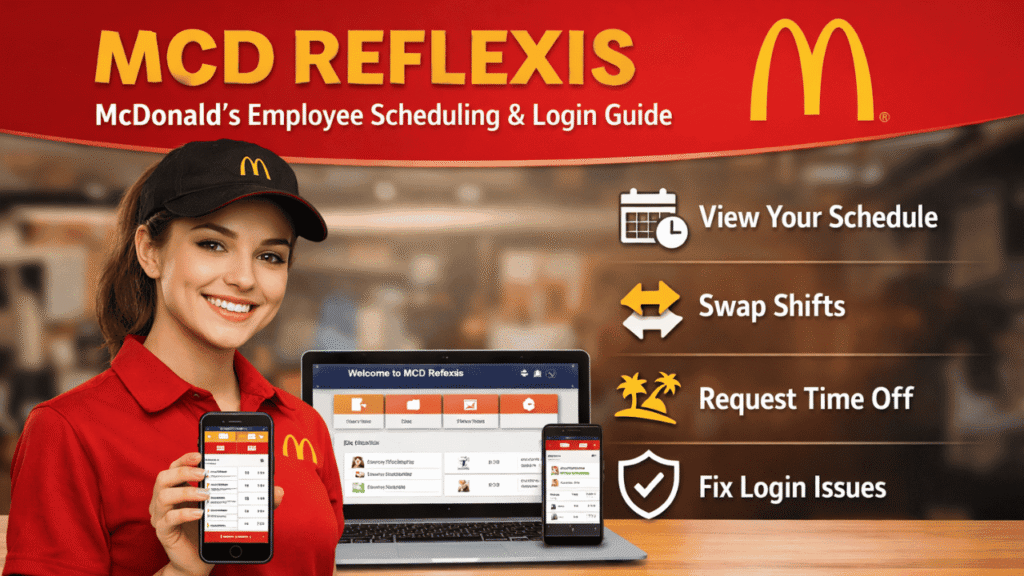
McD Reflexis refers to the workforce management and scheduling system used within McDonald’s operations, particularly across large-scale restaurant networks where staff coordination, shift planning, and labour efficiency are essential. In the UK, where McDonald’s operates thousands of restaurants under both corporate and franchise ownership, McD Reflexis plays a crucial role in ensuring that daily operations run smoothly while maintaining consistency, compliance, and service quality.
At its core, McD Reflexis is designed to simplify how managers schedule employees, allocate shifts, forecast labour demand, and respond to operational needs in real time. It is built around the idea that fast food businesses operate in highly dynamic environments, where customer traffic can change rapidly depending on time of day, season, weather, or local events. Without a structured system like Reflexis, managing these fluctuations would become complex and inefficient.
The connection between McDonald’s and Reflexis, now associated with Reflexis workforce management solutions, represents a shift towards digital transformation in the quick-service restaurant industry. Instead of relying on manual spreadsheets or traditional rota systems, McDonald’s uses advanced scheduling software to optimise labour usage and improve both employee satisfaction and customer service delivery.
In the UK market, McD Reflexis is particularly important due to strict labour laws, working time regulations, and increasing expectations around flexible working arrangements. This system ensures that restaurant managers can meet business needs while also respecting employee availability and legal compliance requirements. As a result, McD Reflexis is not just a scheduling tool but a strategic operational platform that supports long-term efficiency and scalability.
Understanding how McD Reflexis works provides valuable insight into how one of the world’s largest fast-food chains maintains consistency across thousands of locations while still adapting to local operational demands. It is a blend of technology, workforce planning, and operational intelligence designed to keep restaurants running at peak efficiency.
Understanding the McD Reflexis System in McDonald’s Operations
McD Reflexis is deeply embedded in the daily workflow of McDonald’s restaurants, particularly in how managers plan shifts and how employees interact with their schedules. It functions as a centralised digital platform that connects workforce planning with real-time operational data. This allows restaurant managers to make informed decisions about staffing levels based on predicted customer demand.
Within the McDonald’s ecosystem, represented globally by McDonald’s, McD Reflexis acts as a bridge between corporate planning and individual restaurant execution. It takes into account historical sales data, seasonal trends, promotional campaigns, and local factors that influence customer traffic. By processing this data, the system generates staffing recommendations that help managers ensure they are neither overstaffed nor understaffed during critical trading hours.
In practical terms, McD Reflexis helps managers create weekly and daily schedules that align employee availability with operational needs. It allows for adjustments when unexpected changes occur, such as staff absence, sudden increases in customer demand, or special events that impact restaurant traffic. This flexibility is particularly important in the UK, where labour efficiency and cost control are key performance indicators for franchise success.
The system also plays a role in improving communication between managers and employees. Staff members can view their schedules, request shift changes, and receive updates through integrated digital interfaces. This reduces misunderstandings and improves overall workplace transparency. Employees benefit from having clearer visibility of their working hours, while managers benefit from reduced administrative workload.
Overall, McD Reflexis is designed to bring structure, predictability, and adaptability into a highly fast-paced environment. It ensures that McDonald’s restaurants across the UK can maintain consistent service standards while operating efficiently under varying conditions.
How McD Reflexis Transforms Workforce Scheduling in UK Restaurants
Workforce scheduling is one of the most complex aspects of managing a fast-food restaurant, especially in a high-volume brand like McDonald’s. McD Reflexis transforms this process by replacing manual scheduling methods with data-driven automation and predictive planning tools.
In traditional scheduling systems, managers often relied on experience and intuition to assign shifts. While this approach can work in smaller environments, it becomes less effective when dealing with multiple employees, varying availability, and fluctuating customer demand. McD Reflexis addresses these challenges by analysing data patterns and suggesting optimal staffing levels for each time period.
In UK restaurants, this is particularly valuable because customer traffic patterns are influenced by factors such as commuting hours, weekend shopping trends, school holidays, and local events. McD Reflexis processes these variables to help managers build schedules that align closely with expected demand. This reduces both labour waste and service delays.
Another key transformation introduced by McD Reflexis is its ability to support flexible scheduling. Employees often have different availability requirements, especially students or part-time workers who make up a significant portion of McDonald’s workforce in the UK. The system allows managers to balance employee preferences with operational needs, creating schedules that are more fair and efficient.
Additionally, McD Reflexis improves responsiveness. If a shift needs to be adjusted due to unexpected changes, managers can quickly update schedules and notify employees through the system. This real-time adaptability ensures that restaurants remain fully operational even under changing circumstances.
By automating and optimising scheduling, McD Reflexis significantly reduces administrative burden while improving workforce satisfaction and operational consistency. It represents a shift from reactive scheduling to proactive workforce planning.
Key Features of McD Reflexis in McDonald’s UK Operations

McD Reflexis includes several core features that make it a powerful workforce management tool for McDonald’s restaurants. These features are designed to streamline operations, improve accuracy in planning, and enhance communication between staff and management.
One of the most important features is predictive labour forecasting. This allows the system to estimate how many employees are needed at different times of the day based on historical sales data and current trends. This forecasting capability ensures that staffing levels are aligned with expected customer demand, reducing both overstaffing costs and understaffing risks.
Another key feature is automated shift scheduling. Instead of manually assigning shifts, managers can rely on system-generated recommendations that take into account employee availability, labour laws, and business requirements. This reduces scheduling errors and improves fairness in shift distribution.
McD Reflexis also includes real-time schedule adjustments, which are essential in fast-paced restaurant environments. Managers can quickly respond to unexpected changes such as employee absences or sudden spikes in customer traffic. These adjustments are instantly communicated to staff, ensuring smooth operational continuity.
Employee self-service functionality is another important aspect. Staff members can access their schedules, request time off, and manage availability preferences through the system. This improves transparency and gives employees more control over their work-life balance, which is particularly important in the UK labour market.
Reporting and analytics features also play a significant role. Managers can review performance metrics related to labour efficiency, staffing costs, and shift coverage. These insights help improve decision-making over time and support better operational planning.
Together, these features make McD Reflexis a comprehensive workforce management solution that supports both operational efficiency and employee engagement.
Benefits of McD Reflexis for McDonald’s Franchise Operations in the UK
For McDonald’s franchise operators in the UK, McD Reflexis provides a range of operational, financial, and managerial benefits. One of the most significant advantages is improved labour cost control. By ensuring that staffing levels match customer demand, restaurants can avoid unnecessary labour expenses while maintaining high service standards.
Another major benefit is increased operational efficiency. With automated scheduling and forecasting, managers spend less time on administrative tasks and more time focusing on customer service and team leadership. This improves overall restaurant performance and enhances the customer experience.
McD Reflexis also contributes to better compliance with UK labour regulations. Working time rules, break requirements, and contract obligations can be complex to manage manually. The system helps ensure that schedules are created in accordance with legal requirements, reducing the risk of compliance issues.
Employee satisfaction is another key benefit. When staff receive fair and predictable schedules, they are more likely to feel valued and engaged in their roles. McD Reflexis supports this by offering greater transparency and flexibility in shift management.
From a franchise perspective, consistency is essential. McD Reflexis ensures that all restaurants follow similar scheduling standards, which helps maintain brand consistency across the UK. Whether a customer visits a McDonald’s in London or Manchester, the level of service is supported by well-managed staffing structures behind the scenes.
Ultimately, McD Reflexis helps franchise owners achieve a balance between profitability, efficiency, and employee wellbeing.
Employee Experience and Shift Management in McD Reflexis
The employee experience is a critical part of McD Reflexis, particularly in a sector where shift work is common and flexibility is highly valued. In McDonald’s UK restaurants, employees rely on the system to understand their working hours, plan personal commitments, and manage availability.
McD Reflexis improves shift management by providing clarity and consistency. Employees can view their schedules in advance, which helps reduce uncertainty and improves work-life balance. This is especially important for part-time workers and students who need to coordinate work with education or other responsibilities.
The system also allows employees to communicate availability preferences, making it easier for managers to create schedules that accommodate individual needs. While operational requirements remain the priority, this level of flexibility helps create a more supportive working environment.
Shift changes and updates are handled more efficiently through McD Reflexis. Instead of relying on manual communication or last-minute phone calls, updates are delivered through the system, ensuring that employees are always informed. This reduces confusion and improves reliability in shift planning.
In addition, McD Reflexis contributes to fairness in scheduling. By using data-driven logic, the system helps distribute shifts more evenly, reducing bias and improving trust between employees and management. This is particularly valuable in large teams where scheduling fairness can significantly impact morale.
Overall, McD Reflexis enhances the employee experience by making shift management more transparent, flexible, and structured.
Operational Efficiency and Labour Optimisation with McD Reflexis
Operational efficiency is at the heart of McD Reflexis. In a fast-paced restaurant environment, even small improvements in labour planning can lead to significant gains in productivity and cost savings.
McD Reflexis optimises labour by ensuring that the right number of staff are scheduled at the right times. This reduces idle time during quiet periods and prevents understaffing during peak hours. The result is smoother operations and faster service times, which directly impacts customer satisfaction.
Labour optimisation also helps reduce unnecessary overtime costs. By accurately forecasting demand, managers can avoid scheduling excessive hours while still meeting operational requirements. This is particularly important in the UK, where labour costs are a major factor in overall restaurant profitability.
The system also improves task allocation within shifts. By aligning staffing levels with operational needs, managers can ensure that employees are assigned appropriate roles during their shifts. This improves workflow efficiency and reduces bottlenecks during busy periods.
McD Reflexis further enhances operational consistency across multiple locations. Franchise owners can standardise labour practices while still allowing for local adjustments based on specific demand patterns. This balance between consistency and flexibility is a key strength of the system.
In essence, McD Reflexis helps McDonald’s restaurants operate like well-coordinated systems where labour is continuously aligned with demand.
Compliance and UK Labour Regulations in McD Reflexis
Compliance is a critical aspect of workforce management in the UK, and McD Reflexis plays an important role in supporting legal adherence. UK labour laws include regulations around working hours, rest breaks, minimum wage, and fair scheduling practices.
McD Reflexis helps managers stay compliant by incorporating these rules into the scheduling process. When shifts are created, the system automatically considers constraints such as maximum working hours and required rest periods. This reduces the risk of accidental violations and ensures that employee wellbeing is protected.
The system also supports record-keeping, which is important for audits and internal reviews. Accurate records of working hours and shift patterns help demonstrate compliance with labour regulations and support transparent workforce management practices.
In addition to legal compliance, McD Reflexis supports internal company policies related to fairness and consistency. McDonald’s UK operations place a strong emphasis on structured workforce planning, and the system helps enforce these standards across all locations.
By integrating compliance into everyday scheduling, McD Reflexis reduces administrative risk and helps maintain a legally sound working environment for both employees and franchise operators.
Integration of McD Reflexis with McDonald’s Digital Ecosystem
Modern McDonald’s operations rely heavily on digital systems, and McD Reflexis is part of a broader technological ecosystem that supports restaurant management. It integrates with other operational tools to ensure seamless data flow between different aspects of the business.
This integration allows labour scheduling to be aligned with sales forecasting, inventory management, and performance tracking. When systems work together, managers gain a more complete view of restaurant operations and can make better-informed decisions.
Within the broader McDonald’s infrastructure, McD Reflexis helps ensure that workforce planning is not isolated but connected to real business performance. This integration improves accuracy in forecasting and helps align staffing decisions with financial goals.
It also supports communication between corporate teams and individual restaurants. Data collected through McD Reflexis can be used to identify trends, improve operational strategies, and refine scheduling models over time.
By functioning as part of an integrated digital ecosystem, McD Reflexis enhances overall business intelligence and supports continuous improvement across McDonald’s UK operations.
Challenges and Limitations of McD Reflexis in Real-World Use
While McD Reflexis offers significant benefits, it is not without challenges. One of the main limitations is the reliance on accurate data. If input data is incomplete or outdated, forecasting accuracy may be affected, leading to suboptimal scheduling decisions.
Another challenge is adaptability during highly unpredictable events. While the system is designed to handle variability, extreme fluctuations in demand or unexpected staffing shortages may still require manual intervention from managers.
Employee adaptation can also be a factor. Not all staff may initially be comfortable with digital scheduling systems, particularly those who are less familiar with mobile or online tools. Training and support are often required to ensure smooth adoption.
From a managerial perspective, over-reliance on automated suggestions can sometimes reduce human judgement in decision-making. While McD Reflexis provides valuable recommendations, experienced managers still play a crucial role in interpreting data and making final decisions.
Despite these challenges, the overall impact of McD Reflexis remains highly positive when implemented effectively within McDonald’s operations.
The Future of McD Reflexis and Workforce Technology in the UK
The future of McD Reflexis is closely linked to advancements in artificial intelligence, data analytics, and automation. As workforce management systems continue to evolve, McD Reflexis is expected to become even more predictive, responsive, and personalised.
In the UK, where labour markets are increasingly dynamic, the demand for flexible and intelligent scheduling systems will continue to grow. McD Reflexis is likely to incorporate more advanced forecasting models that take into account a wider range of variables, including real-time external data such as weather patterns and local events.
There is also potential for greater employee personalisation, where scheduling systems better adapt to individual preferences while still meeting operational requirements. This would further enhance employee satisfaction and retention.
As part of Reflexis workforce management evolution, McD Reflexis will continue to play a key role in shaping how large-scale restaurant chains manage labour in an increasingly digital world.
The long-term direction points towards more intelligent, automated, and integrated systems that reduce manual effort while improving decision-making quality.
Conclusion: The Importance of McD Reflexis in Modern McDonald’s Operations
McD Reflexis represents a fundamental shift in how workforce management is handled within McDonald’s restaurants across the UK. It brings together data-driven forecasting, automated scheduling, compliance support, and employee engagement into a single unified system.
By improving efficiency, reducing labour costs, and enhancing employee satisfaction, McD Reflexis has become an essential tool for modern restaurant operations. It allows McDonald’s to maintain consistency across thousands of locations while still adapting to local demand patterns and workforce needs.
In an industry where timing, efficiency, and customer experience are critical, McD Reflexis provides the structure and intelligence needed to keep operations running smoothly. As workforce technology continues to evolve, its role will only become more significant in shaping the future of fast-food management in the UK.
You may also read: Political Career and Its Impact on Her Financial Position